For beginners! Basic rules of color scheme [Color magician]

Hello,
"Pu ("Pu" is a half-width kana)".
(You don't have to pronounce the part of ("pu" is a half-width kana))
Suddenly, have you ever struggled with "color schemes" in your design?
Color combinations are very important in design.
However, color schemes are difficult for beginners to get started with, and they often don't know where to start.
In fact, even as a designer, I often have trouble with color schemes.
So this time, the active designer "Pu" is for design beginners,
I would like to tell you the basic rules of color scheme and tips for using colors that look beautiful in an easy-to-understand manner!
Contents
- 1 Basic rules
- of color schemes2 Tips
- for deciding on color schemes3 Mindset for creating a beautiful color scheme4 Conclusion
Contents
Basic rules for color schemes >
Colors have a role
Before thinking about color schemes, let's understand the basic role of colors.
This time, I will explain our website as an example.
Main color (main color)
These colors are the theme of the entire design.
It plays an important role in determining the overall impression.
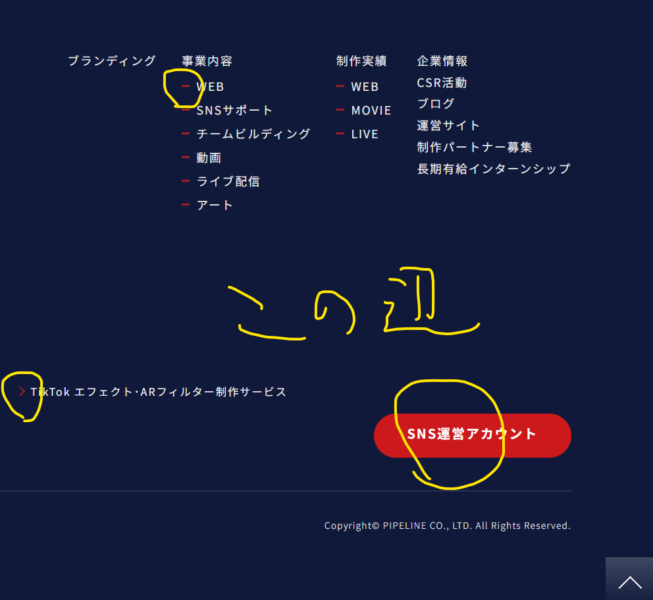
On our site, we use gray colors such as #F7F9FF and #F5F6F7 as the main colors.
By the way, gray colors contain a sophisticated and stylish image, so
It is the perfect color for formal sites such as corporate sites. 
Auxiliary colors (sub-colors)
This color has the role of complementing the main color.
It balances the whole thing or highlights the main color.
We use dark blue and blue colors such as #10193A and #435CB6 as sub-colors.
This is also a cool and sophisticated coloring that has the same image as the gray system.
In addition, in our case, dark blue is used for the text part of the logo, so similar colors are also used for the sub-colors.
In this way, there are many examples of logo colors being used for the color scheme of websites and flyers.

Accent color
These are the colors you use to make an impact on your design.
In our case, the red color centered on #CC191C in the logo is used as an accent.
Red is so noticeable that it is also called a warning color, and
Basically, rather than using it as the main color, it has the effect of tightening the design by using it a little as an accent color.
Recommended color scheme ratio
The "70:25:5" rule is recommended for beginners.
This is how you use a ratio of 70% main color, 25% secondary color, and 5% accent color.
Just by adhering to this law, it will be easier to balance the colors.
Tips for deciding on a color scheme
Use the color wheel
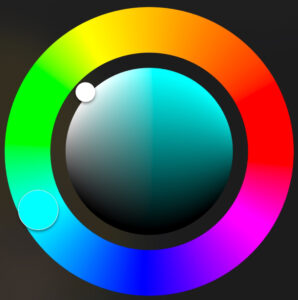
The "color wheel" is a useful tool when thinking about color schemes. The following combinations can help you easily create a color scheme that looks beautiful.
Similar color scheme
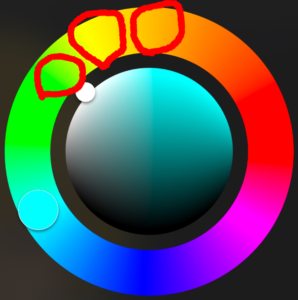
This is a method of combining adjacent colors with the color wheel. It is useful when you want to create a sense of unity and calmness.
Complementary color scheme
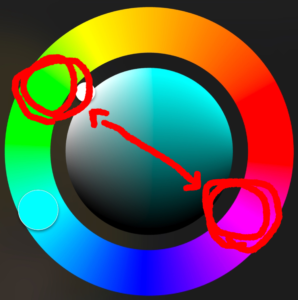
This is a method of combining colors that are in the exact opposite position on the color wheel. It is suitable for contrasting and noticeable designs.
Triad color scheme
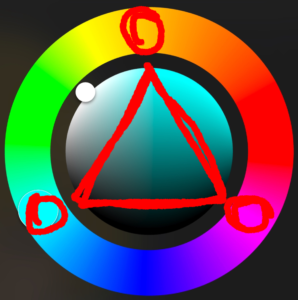
This is a method of combining three colors to create an equilateral triangle on the color wheel. A balanced color scheme is obtained.
Base color is achromatic
For beginners, it is easy to put together a base color with achromatic colors such as white, black, or gray.
Using achromatic colors in the background and margins will make it easier for other colors to stand out.
In fact, our site also has a base color achromatic.
Narrow down the number of colors
It isrecommended to limit the number of colors used in the design to 3~4 colors at most.
If you use too many colors, it will lose its sense of unity and give it a messy impression.
Here are the results that were too cluttered (beware of browsing)
mindset for creating a beautiful color scheme
Think about your purpose
When considering a color scheme, be mindful of the purpose and message of your design.
For example, it is important to use the impression of colors, such as blue if you want to give a sense of trust, or orange or yellow if you want to give a cheerful impression.
Be conscious of simplicity
Beginners tend to have a variety of gradients, flashy speech bubbles, and lines.
I understand the desire to try various things, but sometimes it's important to subtract.
If you don't add too many colors and make good use of the margins to create a simple color scheme, even beginners will look sophisticated.
Don't be afraid of failure
The more you think about design, the more you get stuck in the swamp and can't get out.
It's okay not to aim for perfection from the start. Through trial and error, you will find your favorite and color scheme!
summary
what did you think?
Color matching is difficult but interesting.