What is team building training using Lego Serious Play?
,
This is Shonton from "Lego ® Serious Play ® Certified Facilitator".
In this article, I will write more about Lego Serious Play training.
Contents
- 1 Lego Serious Play Basics
- 2 The effect of Lego Serious Play in training
- 3 Example of a practical training program: Training
- using Lego Serious Play 4 How to design and implement a workshop program
- 5 Participant feedback and outcomes
- 6 Planning and implementation of the LEGO Serious Play Training
- 7 The future and possibilities
- of Lego Serious Play8 Conclusion
Contents
- 1 the basics of Lego Serious Play
- 2 The effect of Lego serious play in training
- 3 Example of a training program in action: Training using Lego Serious Play
- 4 How to design and implement a workshop program
- 5 participant feedback and outcomes
- 6 planning and implementation of LEGO serious play training
- 7 The Future and Potential of Lego Serious Play
- 8 summary
the basics of Lego Serious Play
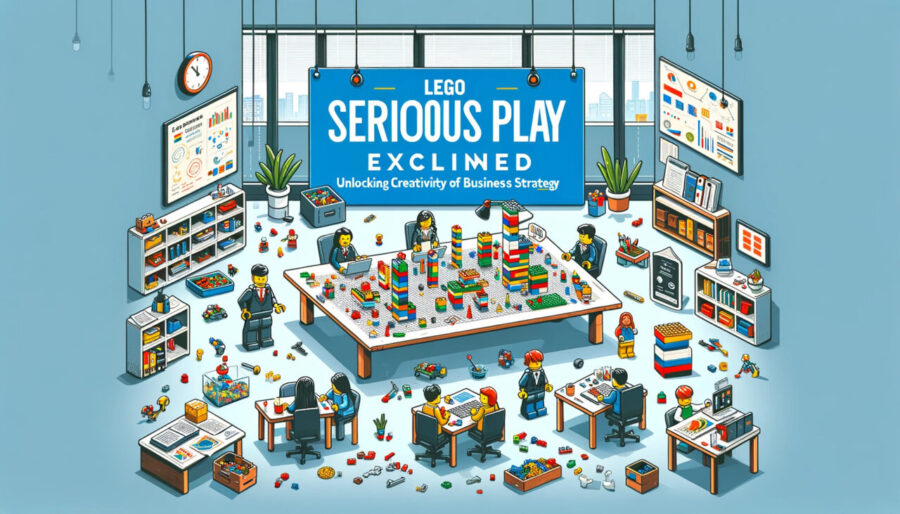
LEGO Serious Play is a workshop developed by the Danish toy manufacturer LEGO® that is used in various business scenarios such as meetings, team building, problem-solving and strategic planning.
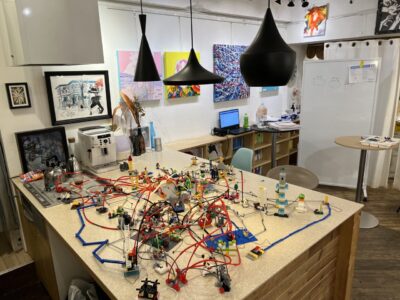
In this method, participants use specialized Lego bricks to build ideas and concepts into physical models <>span style="color: #ff0000;".
By talking, sharing, and discussing their respective models, participants visualize complex ideas and problems, fostering a deeper understanding.
This technique is effective in promoting communication, fostering creativity, and improving teamwork, and is adopted by many companies and organizations around the world.
History of Lego Serious Play
- Beginning of development: It was developed in the late 1990s by the Danish company Lego. This method was conceived as a new approach to solving complex problems faced in the business world.
- Academic Foundation: Further developed by Swiss management scholars Johan Roth and Bert Victor as a tool for strategy development and organizational learning. They proposed a way to use Lego bricks to gain deep insights through an intuitive and creative process.
- Popularization: In the early 2000s, Lego Serious Play was officially released as a product and has since been adopted by many companies and educational institutions around the world.
How to facilitate intra-organizational communication
- Communication and Cooperation: Lego Serious Play focuses on participants using Lego bricks to embody their thoughts and feelings and then share them with other participants.
- Metaphors and Storytelling: Participants talk about their models and convey complex concepts and strategies through metaphors and storytelling.
- Visualization of Thoughts: By building a physical model, we visualize thoughts that would normally be difficult to express in words alone.
- All-Participant Participation: This technique encourages everyone to participate and contribute equally, even listening to voices that are not normally heard.
Examples of activities using Lego bricks
Activities using LEGO ®Serious Play ®are designed to promote creativity and communication.
Here are some examples of activities:
1. Create a self-introduction model
Purpose: To deepen understanding among team members through self-introduction.
Method: Participants create a LEGO model that represents them and explain their meaning to the team.
2. Visualize your team's strengths and challenges
Purpose: To share and understand the team's strengths and areas for improvement.
How: Team members create models with LEGO bricks that symbolize the team's strengths and challenges and share them with the group.
3. Building a vision for the future
Purpose: To clarify the team's goals and vision for the future.
How: Team members use LEGO bricks to build models that represent the team's future vision and discuss them.
4. Idea generation for problem solving
Purpose: To generate new ideas for problem solving.
How: Use LEGO bricks to model solutions to specific problems or challenges, which can be shared and discussed within the team.

The effect of Lego serious play in training
By incorporating Lego serious play into your training, you can expect many positive effects.
Fostering creativity and innovation
Stimulating Creative Thinking: Activities with Lego bricks stimulate participants' imagination and encourage creative thinking.
Source of innovation: It inspires new ideas and innovative solutions through unconventional thinking.
The Importance of Team Building and Collaboration
Enhanced Collaboration and Teamwork: Collaborative modeling enhances collaboration and teamwork among participants.
Promoting mutual understanding: When team members share their perspectives and ideas, they deepen mutual understanding.
Improve problem-solving skills
Complex Problem Visualization: Visually represent complex problems through LEGO models to enhance our understanding of the problem.
Building Concrete Solutions: Participants can work together to build solutions with LEGO models to create a tangible action plan.

Example of a training program in action: Training using Lego Serious Play
Real-life examples
Case 1: Team building training at an IT company. In this program, participants used LEGOs to express their team's strengths and challenges. As a result, team communication has improved and project efficiency has increased.
Case 2: Strategy planning workshop at an educational institution. Teachers and students used LEGO together to form the concept of a new educational program. This technique has led to diverse ideas and the development of practical educational curricula.
Success Factors
Promoting Shared Understanding: By using Lego, we were able to share ideas visually and deepen understanding among participants.
Promoting creativity: Unlike regular meetings and discussions, LEGO stimulated participants' creativity and generated innovative ideas.
How to design and implement a workshop program
Design of training programs
Set Goals: Clearly set the objectives for your Lego serious play. For example, team building, problem solving, and strategic planning.
Participant Selection: Selecting participants from diverse backgrounds allows for diverse perspectives.
Preparation for implementation
Material Preparation: Ensure the type and quantity of Lego bricks.
Time Allocation: Plan the time for each session in advance to ensure efficient progression.
Facilitation: Expert facilitators facilitate discussions and create an environment where everyone participates.
participant feedback and outcomes
The importance of feedback
Through direct feedback from participants, the effectiveness of the training will be evaluated.
Feedback can help us improve our training in the future.
Concrete results
In a team building case, there is a report that the team's productivity increased by 20% after training.
In the case of an educational institution, the results showed that the new curriculum was actually adopted, resulting in increased student satisfaction.
planning and implementation of LEGO serious play training
We'll take a closer look at how to plan and implement Lego Serious Play when incorporating it into your training.
Setting training objectives and goals
Clear Objectives: Clearly set the objectives of the training and plan activities based on them.
Goal Specificity: Set specific goals for participants to achieve and clarify the expected outcomes.
Key points for effective program design
Participant Engagement: Try to design it so that participants can actively participate and immerse themselves in the training.
Variety of activities: Keep participants interested by incorporating different types of activities to avoid monotony.
Roles and qualities of a facilitator
Importance of Facilitator: The role of the facilitator is important to ensure that the training runs smoothly and guides the participants.
Required Skills and Qualities: A good facilitator requires good communication skills, observational skills, and flexible thinking.
The Future and Potential of Lego Serious Play
Lego Serious Play can be applied in various fields beyond the framework of training.
Examples of applications outside of training
Education: Used in schools and educational institutions to foster creativity and support learning.
Team building: Used by companies as well as sports teams and communities.
Potential for integration with technology
Utilization of digital tools: A new form of Lego serious play using augmented reality (AR) and virtual reality (VR).
Online Sessions: Deploy Lego Serious Play in remote work and online environments.
Long-term impact on organizational development
Continuous Growth: Utilize the insights gained through training for organizational development, fostering continuous growth.
Organizational Culture Transformation: Transform organizational culture positively by fostering creativity and open communication.
summary
Lego Serious Play is not just a play but a powerful tool for organizational and personal growth. By utilizing this technique, you can enhance your creativity, teamwork, and problem-solving skills. Lego Serious Play, which is expected to be applied not only in training but also in various situations, has many possibilities in the future.
Click hereto know more ↓
https://www.pipe-line.biz/legoseriousplay